|
|
|
| |
|
|
| |
|
Stuff About Me, Research, Language Testing and Assessment
I am Emeritus Professor of Applied Linguistics and Language Assessment in the UK. My main interests lie in the field of language testing and the philosophy of assessment. I have extensive experience of working on test design and development projects.I have specific expertise second language speaking rating scales. I developed the first data-driven rating scales between 1987 and 1993, and have continued to conduct research in this area ever since.
I have worked for a number of major testing companies in a research or consultancy capacity on test development projects, alignment studies, and conducting item writer/rater training. I have published widely in the field, and you can see (and download) some of my work below.
I was Editor of Language Testing (Sage) from 2006 to 2015, and from 2016 I continued as podcast editor until 2021. I served on the Executive Board of the
International Language Testing Association (ILTA) from 1998 - 2000. In 2005 I was elected Vice President, served as President in 2006, and then as ex-officio Immediate Past President from 2007 - 2008. During 2009 I was a Leverhulme Research Fellow. I am grateful to the Leverhulme Trust which awarded me a substantial grant to pursue research in language testing literacy, leading to the publication of a model of language testing literacy in Language Assessment Quarterly, the upgrading of this website, and Practical Language Testing.
|
Qualifications
BD (London)
AKC (London)
PGCE (Cambridge)
MTh (London)
MA Applied Linguistics (Birmingham)
PhD (Lancaster)
|

|
 Here's a picture of me in my library, taken when I was deeply engrossed in writing Language Testing Re-examined. See information below. I live in the beautiful county of Leicestershire. The photos above are all taken within a 20 minute walk of my home. My hobbies include music theory and guitar, reading, walking, the gym, and improving my Koine Greek. I spend a lot of time in my garden, and if you're interested in garden birds, here is a video of some that visit regularly.
 |
|
In 2013 I was awarded a University Teaching Fellowship for excellence in teaching language testing, based on my work in assessment literacy funded by the Leverhulme Trust. In June 2014 I was made a National Teaching Fellow of the Higher Education Academy for my work in promoting teaching and learning in language testing and assessment. 2014 was the only year in which my University received three such awards, which was reported in LE1 Magazine. In 2021 I received the Messick Memorial Award from ETS, and in 2022 I was elected a Fellow of the Academy of Social Sciences
In 2022 Language Teaching Research Quarterly published a kind Festschrift, in which you may be interested, three papers of which I provide here:
- Introduction
- Interview
- Systematic Review
My Google Scholar Profile
|
|
|
| |
|
|
|
|
| |
|
|
| |
Fulcher, G. (2025). Practical Language Testing 2nd Edition.
London: Hodder Education/Routledge.
ISBN 9781032447285; 364 pages.
The 2nd edition of Practical Language Testing has been widely edited and brought up to date from the first edition, with a stronger focus on test building and validation. To achieve this there is a new chapter on validity, covering traditional formulations through Messick, the post-Messick fragmentation, and reintegration through effect-driven testing. The approach is both descriptive and critical.
This is the only language testing textbook that is based on research into language assessment literacy and a clear pedagogic model. The first stage of the research, funded by the Leverhulme Trust, was a definition of what we need to know as practitioners to design and build tests. Read this research here:
Fulcher, G. (2012). Assessment literacy for the language classroom. Language Assessment Quarterly 9, 2, 113 - 132.
The structure was then turned into an approach to pedagogy based on the pre-Aristotelean notion of apprenticeship, which combines practice and theory in the act of creation. You can read about this model, which informs the approach to learning in the book here:
Fulcher, G.(2020). Operationalizing Assessment Literacy. In Tsagari, D. (Ed.) Language Assessment Literacy: From Theory to Practice (pp. 8 -28). Cambridge: Cambridge Scholars.
The book looks at both high-stakes and classroom oriented assessment. I argue that that these are different paradigms, with very different validity criteria. You may read about the outline of this theory that informs the structure and content of chapters 2 and 3 here:
Fulcher, G. (2021). Language Assessment Literacy in a Learning-Oriented Assessment Framework. In Gebril, A. (Ed.) Learning-oriented language assessment: Putting theory into practice. London and New York: Routledge.
|
|

|
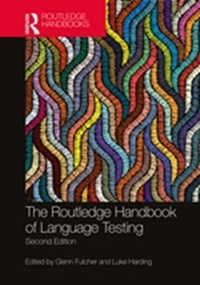
Fulcher, G. & Harding L. (2022). The Routledge Handbook of Language Testing. 2nd Edition.
London & New York: Routledge.
Click here to download the Handbook Preview in PDF, including editorial, contents, authors, and reading lists.
Endorsements
"The first edition of this volume received the highest possible kudos of any book in the field of language testing through receipt of the SAGE/International Language Testing book prize. This set a high and seemingly unattainable bar for the second edition. Remarkably, the current collection has paralleled and possibly even surpassed the excellence of the earlier edition. By compiling the latest thinking of a varied and high-caliber roster of contributors and serving as a crucial benchmark for tracking developments, the collective wisdom in this volume will, no doubt, continue to shape the future of the field. This book is an indispensable resource for new and seasoned language testing researchers and practitioners alike. Due to its interdisciplinary nature, I would highly recommend it for libraries at all institutions offering training in applied linguistics or related subjects."
Talia Isaacs, University College London, UK |
"Editors Fulcher and Harding have invited leading researchers across the globe to identify critical issues in the field of language testing and assessment and to make predictions about its future. 36 chapters, covering philosophical, social and technical aspects of the discipline, offer thought-provoking reading for anyone engaging with language tests, whether as researcher, practitioner or policy-maker."
Catherine Elder, University of Melbourne, Australia |
|
|
|
The book has a companion website to elucidate the content of the chapters
Endorsements
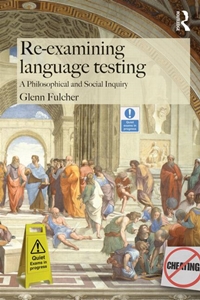
"The creation of the field of psychometrics set out to reduce the uncertainty of measuring human abilities but not to deal with the underlying philosophical problem. Now, in this pioneering rethinking of the fundamental questions involved, Fulcher has finally tackled the basic issues. There can be no question as to the importance of this book."
Bernard Spolsky, Bar-Ilan University, Israel |
"Fulcher's philosophical approach to language testing as a profession is both enlightening and thought provoking. It will present a major challenge for language testers in the years to come."
Yan Jin, Shanghai Jiao Tong University, China |
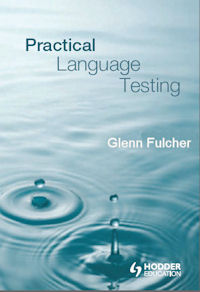
Fulcher, G. (2010). Practical Language Testing.
London: Hodder Education/Routledge.
ISBN-10: 0340984481; 342 pages + xiv.
|
|
|
The research for this book has kindly been supported by the The Leverhulme Trust, which awarded me a Leverhulme Research Fellowship to fund the research and study leave. I am also grateful to the University of Leicester, which granted me study leave.
Read the Reviews here
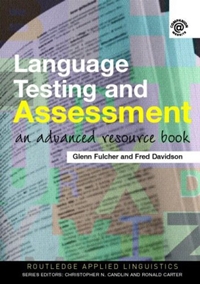
Fulcher, G. and Davidson, F. (2007).
Language Testing and Assessment
London & New York: Routledge.
ISBN: 0415339472. 424 pages.
|
|
|
Read the Reviews here
|
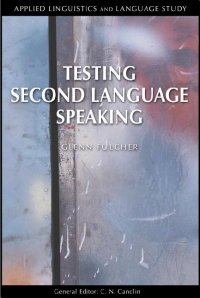
Fulcher, G. (2003). Testing Second Language Speaking
London: Longman/Pearson Education.
ISBN: 0582-472709. 312 pages.
|
|
|
Read the Reviews here
|
Fulcher, G. and Davidson, F. (2012) (Eds.) The Routledge Handbook of Language Testing.
London and New York: Routledge. ISBN: 0415570638, 560 pages.
2nd Edition Planned for 2021/2022, edited by Glenn Fulcher and Luke Harding
 Winner of the 2016 SAGE/ILTA Book Award.
Hover here to see the selection committee citation.
|
|
|
|

|
Endorsements
'This thorough and comprehensive introduction to the practical and theoretical dimensions of language testing and assessment is set to become a standard reference. With chapters by leading international authorities in the field, it is both intellectually stimulating and practically useful, and is a must-read for those involved in language testing as test developers, test users, policy makers and researchers.'
Tim McNamara, The University of Melbourne, Australia
'I found this book to be the finest collection of cogent articles on language testing to date. The Handbook solidifies language testing as a discipline in its own right - one that has real-world impacts on society at large. Stimulating and clear, the articles will be a valuable resource for decades to come.'
Paula Winke, Michigan State University, USA
|
|
| |
|
|
|
|
| |
|
|
| |

|
Performance Testing and Scoring
|
Xi, X., Norris, J., Ockey, G., Fulcher. G., & Purpura, J. (2021). Assessing Academic Speaking. In Xi, X. and Norris, J. (Eds.) Assessing Academic English for Higher Education Admissions. London and New York: Routledge.
Ji Yi and Fulcher, G. (2018). Strategy Use in the TOEFL iBT Speaking Test and Academic Classroom. Korean Journal of Applied Linguistics, 34(1), 223-252.
Fulcher, G. (2018) "Assessing Spoken Production", in The TESOL Encyclopedia of English Language Teaching Vol 8, (pp. 4900 - 4906). Edited by John I. Liontas (Project Editor: Margo DelliCarpini; Volume Editor (Coombe, C.), Hoboken, USA: John Wiley & Sons, Inc.
 Browne, K & Fulcher, G. (2017). Pronunciation and Intelligibility in Assessing Spoken Fluency. In Isaacs, T. & Trofimovich, P.(Eds.) Second Language Pronunciation Assessment. Bristol: Multilingual Matters.
Fulcher, G. (2016). Criteria for Evaluating Language Quality. In Shohamy, E. (Ed). Language Testing and Assessment. Vol. 7. of the Encyclopaedia of Language and Education. New York: Springer. 2nd Edition.
Fulcher, G. (2015). Research timeline: Assessing Second Language Speaking. Language Teaching 48(2), 198 - 216.
Kemp, J. and Fulcher, G. (2013). Performance Decision Trees: Developing domain-specific criteria for teaching and assessment. In J. Wrigglesworth (Ed.) EAP within the higher education garden: Cross-pollination between disciplines, departments and research. (pp. 159 - 170). Reading: Garnet.
Fulcher, G. (2012). "Scoring Performance Tests." In Fulcher, G. and Davidson, F. (Eds.) The Routledge Handbook of Language Testing. London and New York: Routledge, 378 - 392.
Fulcher, G., Davidson, F. & Kemp, J. (2011). "Effective rating scale development for speaking tests: Performance Decision Trees." Language Testing 28, 1, 5 - 29.
Fulcher, G. (2008). "Assessing Language Quality".
In Shohamy, E. (Ed.) Language Testing and Assessment. Vol. 7, Encyclopedia of Language and Education. New York: Springer Publishers, 157 - 176.
Fulcher, G. (2007). "Evaluating quality in second language performance tests." English Language Assessment 1, 3 - 19.
Fulcher, G. (1998). "Testing Speaking". In Clapham, C. (Ed). Language Testing and Assessment. Vol. 7. of the Encyclopaedia of Language and Education, Kluwer Academic Publishers, 75 - 86.
Fulcher, G. (1997). "Assessing Writing". In Fulcher, G. (Ed) Writing in the English Language Classroom. Phoenix ELT/Prentice Hall Macmillan.
Fulcher, G. (1996). "Testing tasks: issues in task design and the group oral." Language Testing 13, 1, 23 - 51.
Fulcher, G. (1996). "Does thick description lead to smart tests? A data-based approach to rating scale construction". Language Testing 13, 2, 208 - 238.
Fulcher, G. (1994). "Some priority areas in oral language testing research." Language Testing Update 15, 39 - 47.
Fulcher, G. (1993).The Construction and Validation of Rating Scales for Oral Tests in English as a Foreign Langauge. Unpublished PhD Dissertation, University of Lancaster, UK. This is a very large file. Once you've clicked, just wait for it to download in a new window. If you're impatient, you'll crash your browser.
Fulcher, G. (1989). Lexis and reality in oral evaluation. US Department of Education, Office of Educational Research and Improvement, and the Centre for Applied Linguistics. ERIC document number: ED 298759.
Fulcher, G. (1987). "Tests of Oral Performance: the need for data-based criteria." English Language Teaching Journal 41, 4, 287 - 291. Browne, K & Fulcher, G. (2017). Pronunciation and Intelligibility in Assessing Spoken Fluency. In Isaacs, T. & Trofimovich, P.(Eds.) Second Language Pronunciation Assessment. Bristol: Multilingual Matters.
Fulcher, G. (2016). Criteria for Evaluating Language Quality. In Shohamy, E. (Ed). Language Testing and Assessment. Vol. 7. of the Encyclopaedia of Language and Education. New York: Springer. 2nd Edition.
Fulcher, G. (2015). Research timeline: Assessing Second Language Speaking. Language Teaching 48(2), 198 - 216.
Kemp, J. and Fulcher, G. (2013). Performance Decision Trees: Developing domain-specific criteria for teaching and assessment. In J. Wrigglesworth (Ed.) EAP within the higher education garden: Cross-pollination between disciplines, departments and research. (pp. 159 - 170). Reading: Garnet.
Fulcher, G. (2012). "Scoring Performance Tests." In Fulcher, G. and Davidson, F. (Eds.) The Routledge Handbook of Language Testing. London and New York: Routledge, 378 - 392.
Fulcher, G., Davidson, F. & Kemp, J. (2011). "Effective rating scale development for speaking tests: Performance Decision Trees." Language Testing 28, 1, 5 - 29.
Fulcher, G. (2008). "Assessing Language Quality".
In Shohamy, E. (Ed.) Language Testing and Assessment. Vol. 7, Encyclopedia of Language and Education. New York: Springer Publishers, 157 - 176.
Fulcher, G. (2007). "Evaluating quality in second language performance tests." English Language Assessment 1, 3 - 19.
Fulcher, G. (1998). "Testing Speaking". In Clapham, C. (Ed). Language Testing and Assessment. Vol. 7. of the Encyclopaedia of Language and Education, Kluwer Academic Publishers, 75 - 86.
Fulcher, G. (1997). "Assessing Writing". In Fulcher, G. (Ed) Writing in the English Language Classroom. Phoenix ELT/Prentice Hall Macmillan.
Fulcher, G. (1996). "Testing tasks: issues in task design and the group oral." Language Testing 13, 1, 23 - 51.
Fulcher, G. (1996). "Does thick description lead to smart tests? A data-based approach to rating scale construction". Language Testing 13, 2, 208 - 238.
Fulcher, G. (1994). "Some priority areas in oral language testing research." Language Testing Update 15, 39 - 47.
Fulcher, G. (1993).The Construction and Validation of Rating Scales for Oral Tests in English as a Foreign Langauge. Unpublished PhD Dissertation, University of Lancaster, UK. This is a very large file. Once you've clicked, just wait for it to download in a new window. If you're impatient, you'll crash your browser.
Fulcher, G. (1989). Lexis and reality in oral evaluation. US Department of Education, Office of Educational Research and Improvement, and the Centre for Applied Linguistics. ERIC document number: ED 298759.
Fulcher, G. (1987). "Tests of Oral Performance: the need for data-based criteria." English Language Teaching Journal 41, 4, 287 - 291.

|
Test and Task Design
|
Green, T. and Fulcher, G. (2021). The Test Design Cycle. In Winke, P. and Brunfaut, T. (Eds.) The Routledge Handbook of Second Language Acquisition and Language Testing. London and New York: Routledge.
Fulcher, G. (2017). The Practice of Language Assessment. In Hinkel, E. (Ed.) Handbook of Research in Second Language Teaching and Learning (pp. 463 - 475). London and New York: Routledge.
Fulcher, G. (2013). "Test Design and Retrofit." In Chapelle, C. A. (Ed.) The Encyclopeidia of Applied Linguistics (pp. 5809 - 5817). Malden MA: Wiley Blackwell
Davidson, F. and Fulcher, G. (2012). "Developing Test Specifications for Language Assessment." In Coombe, C., Stoynoff, S., O'Sullivan, B., & Davidson,P. (Eds.) The Cambridge Guide to Second Language Assessment. Cambridge: Cambridge University Press, 59 - 65.
Fulcher, G. (2007). "Industrial methods for cottage industries? Alternatives for classroom assessment." In Niakaris, C. I. and Nebel, A. (Eds.) Testing and Teaching: Opportunities for Learning. Athens: Hellenic American Union, 44 - 51
Davidson, F. and Fulcher, G. (2007).
"The Common European Framework of Reference (CEFR) and the design of language tests: A Matter of Effect."
Language Teaching 40, 3, 231 - 241.
Fulcher, G. (2006). "Test Architecture."
Foreign Language Education Research, 9, 1 - 22.
Davidson, F. and Fulcher, G. (2006). "Flexibility is proof of a good 'framework'." Guardian Education, 17 November.
Fulcher, G. and Marquez Reiter, R. (2003). "Task difficulty in speaking tests." Language Testing 20, 3, 321 - 344.
Fulcher, G. (1998). "Widdowson's model of communicative competence
and the testing of reading: An exploratory study." System 26, 3, 281 - 302.

|
Issues in Validity and Reliability
|
Fulcher, G. (2016). Standards and Frameworks. In Banerjee, J & Tsangari, D. (Eds.) Handbook of Second Language Assessment, (pp. 29 - 44). Berlin: DeGruyter Mouton.
Fulcher, G. (2015). "Context and inference in language testing. In King, J. (Ed.) Context and the Learner in Second Language Learning (pp. 225 - 241). London: Palgrave Macmillan.
Fulcher, G. (2014). Philosophy and Language Testing. In Kunnan, A. J. (Ed.) The Companion to Language Testing (pp. 1431 - 1451). London: Wiley-Blackwell.
Fulcher, G. & Svalberg, A. M-L. (2013). Limited Aspects of Reality: Frames of reference in language assessment. International Journal of English Studies 13(2). Second language testing: Interfaces between Pedagogy and Assessment.
Xing, P. and Fulcher, G. (2007). "Reliability assessment for two versions of the Vocabulary Levels Test."
System 35, 2, 182 - 191.
Chalhoub-Deville, M. and Fulcher, G. (2003). "The oral proficiency interview and the ACTFL Guidelines: A research agenda."
Foreign Language Annals 36, 4, 498 - 506.
Fulcher, G. (1999). "Assessment in English for Academic Purposes: Putting content validity in its place."
Applied Linguistics 20, 2, 221 - 236
Fulcher, G. (1997). "An English Language Placement Test: Issues in reliability and validity." Language Testing 14, 2, 113 - 139.
Fulcher, G. (1996). "Invalidating validity claims for the ACTFL Oral Rating Scale." System 24, 2, 163 - 172.
Fulcher, G. (1996). "The interplay of evidence in the consideration of variable scores and performance across tasks." In J. Field, A. Graham and M. Peacock (Eds) Insights 1. Kent: IATEFL Publications.
Fulcher, G. (1995). "Variable competence and Second Language Acquisition: A problem for research methodology. System 25, 1, 25 - 33.
Fulcher, G. (1988). "Item Response Theory: what is it?" Education Today 28, 4, 44 - 52.
Fulcher, G. (1987). "Measurement or Assessment: a fundamental dichotomy and its educational implications." Education Today 37, 2, 60 - 65.

|
Pedagogy and Applied Lingistics
|
Fulcher, G. (2009). The commercialization of language provision at University. In Alderson, J. C. (Ed.) The Politics of Language Education: Individuals and Institutions. London: Multilingual Matters, 125 - 146.
Fulcher, G. (2007). "Universities undermine their own foundations." Guardian Education, 13 April.
Marquez Reiter, R., Rainey, I. and Fulcher, G. (2005). "A comparative study of conventional indirectness in British English and Peninsular Spanish." Applied Linguistics 26, 1, 1 - 31
Fulcher, G. and Locke, D. (1999). "Distance Education: The future of library and information services requirements." Distance Education 20, 2, 313 - 329.
Fulcher, G. (1999). "Library and Information Services Requirements: A Course Developer's Perspective." In D. A. Lock (ed.)
Library Services for Distance Learners. Surrey: Proceedings of the first Conference on Library Services for Distance Education. 3 - 8.
Fulcher, G. (1997). "Text difficulty and accessibility: Reading formulae and expert judgement." System 25, 4, 497 - 513
Fulcher, G. (1991). "Conditionals Revisited." English Language Teaching Journal 45, 2, 164 - 168.
Fulcher, G. (1989). "Cohesion and coherence in theory and reading research." Journal of Research in Reading 12, 2, 146 - 163.
Fulcher, G. (1988). "The EFL Classroom as a place for research." Education Today 38, 4, 44 - 52.
Fulcher, G. (1988). "Teaching vocabulary for writing." Modern English Teacher 15, 1, 25 - 30.
Fulcher, G. (1987). "Contextual Hyponymy: a communicative approach to teaching lexis in context." Modern English Teacher 14, 3, 14 - 17.

|
Online Features
|
On this website I periodically publish short articles on subjects that are topical or relevant to what is going on in my language testing classes. You can access a selection from the Features Page.
|
|

|
Social, Political and Ethical Uses of Tests
|
Fulcher, G. (2014). Language testing in the dock. In Kunnan, A. J. (Ed.) The Companion to Language Testing (pp.1553 - 1570). London: Wiley-Blackwell.
Fulcher, G. (2011). Cheating gives lie to our test dependence, Guardian Weekly, 11th October 2011. Or you can download a pdf.
Fulcher, G. (2010). "The reification of the Common European Framework of Reference (CEFR) and effect-driven testing." In Psyaltou-Joycey, A. and Matthaioudakis, M. (Eds.) Advances in Research on Language Acquisition and Teaching. Greece, Thessaloniki: GALA, 15 - 26.
Fulcher, G. (2009). "Test use and political philosophy."
Annual Review of Applied Linguistics 29, 3 - 20.
Fulcher, G. and Davidson, F. (2008).
"Tests in Life and Learning: A Deathly Dialogue."
Educational Philosophy and Theory, 40, 3, 407 - 417.
Fulcher, G. (2008). "Testing Times Ahead?"
Liaison Magazine, Issue 1: July, 20 - 24.
Published by the UK Subject Centre for Languages, Linguistics and Area Studies, University of Southampton.
Fulcher, G. (2005). "Language Framework Documents and the Hallmark of Political Purpose." In Niakaris, C. I. and Nebel, A. (Eds.) Testing and Evaluation. Athens: Hellenic American Union, 28 - 31.
Fulcher, G. (2004). "Deluded by artifices? The Common European Framework and harmonization."
Language Assessment Quarterly, 1, 4, 253 - 266.
Fulcher, G. (2004). "Are Europe's tests being built on an unsafe framework?". Guardian Education, 18 March.
Fulcher, G. (2003). "Few ills cured by setting scores." Guardian Education, 17 April.
Fulcher, G. (1999). "Ethics in Language Testing." TAE SIG Newsletter 1, 1, 1 - 4.
Fulcher, G. and Bamford, R. (1996). "I didn't get the grade I need. Where's my solicitor?" System 24, 4, 437 - 448.

|
Computers, Technology and Testing
|
Fulcher, G. (2005). "Better Communications Test will Silence Critics".
Guardian Education, 18 November.
Fulcher, G. (2003). "Interface design in computer based language testing." Language Testing 20, 4, 384 - 408.
Fulcher, G. (2001). "Machines get cleverer at testing." Guardian Education, 17th May.
Fulcher, G. (2000). "Computers in language testing." In Brett P. and Motteram, G. (Eds.) A special interest in computers: Learning and teaching with information and communications technologies. Manchester: IATEFL publications, 93 - 107.
Fulcher, G. (1999). "Computerizing an English language placement test." English Language Teaching Journal 53, 4, 289 - 299
Fulcher, G. (1998). "Computer-based language testing: The call of the internet." In Coombe, C. A. (Ed.) Current Trends in English Language Testing. UAE: Al Ain University Press. 1 - 14.

|
Teaching, Learning and Assessment
|
Fulcher, G. (2021). Language Assessment Literacy in a Learning-Oriented Assessment Framework. In Gebril, A. (Ed.) Learning-oriented language assessment: Putting theory into practice. London and New York: Routledge.
Fulcher, G. (2021). Language Testing. In Mohebbi, H. and Coombe, C. (Eds.) Research Questions in Language Education and Applied Linguistics. London: Springer.
Fulcher, G.(2020). Operationalizing Assessment Literacy. In Tsagari, D. (Ed.) Language Assessment Literacy: From Theory to Practice (pp. 8 -28). Cambridge: Cambridge Scholars.
Fulcher, G.(2019). Cultivating language assessment literacy as collaborative CPD. In Gillway, M. (Ed.) Addressing the state of the union: Working together, learning together (pp. 27 - 35). Reading: Garnet.
Fulcher, G. and Owen, N. (2016). Dealing with the demands of language testing. In Hall, G. S. (Ed.) The Routledge Handbook of English Language Teaching (pp. 109 - 120). London and New York: Routledge.
Fulcher, G. (2012). Assessment literacy for the language classroom. Language Assessment Quarterly 9, 2, 113 - 132.
Fulcher, G. (2010). "Assessment Literacy for the English Language Classroom." Testing, Evaluation and Assessment Newsletter, IATEFL, September, 6 - 8.
Fulcher, G. (2003). "Scaling the peak of writing assignments/dissertations." Guardian Education, November 21.
Fulcher, G. (2002). "Managers face the tests." Invited editorial for the EFL Gazette, April, Issue 267.
Fulcher, G. (2001). "Communicative Language Testing." In Coombe, C., Riley, S. and Troudi, S. (Eds.) Bridging the Gap between Teacher and Learner. TESOL Arabia, 52 - 68.
Fulcher, G. (2000). "The 'communicative' legacy in language testing." System 28, 4, 483 - 497
Fulcher, G. (2000). "Assessment in Independent Language Learning." In the Curriculum and Independence for the Learner Network Handbook (CIEL)
Fulcher, G. (1996). "Writing in the Classroom" Modern English Teacher, 5, 3, 45 - 48.
Fulcher, G. (1991). "The role of assessment by teachers in schools." In Caudery, T. (ed) New Thinking in TEFL. (The Dolphin Series No. 21), Denmark: Aarhus University Press, 138 - 158.
Fulcher, G. (1990). A GCE O Level Workbook. Mavromatis Books, Nicosia, Cyprus.

|
Book and Software Reviews
|
Fulcher, G. (2005). "Educational Test Analysis." Language Testing Update,36, 152 - 154.
Fulcher, G. (2000). Review of Chalhoub-Deville, M (Ed.) 1999. Issues in computer-adaptive testing of reading proficiency: selected papers. Studies in Language Testing Vol. 10. Cambridge: Cambridge University Press. Language Testing 17, 3, 361 - 367.
Fulcher, G. (1999). Review of Barnwell, D. P. 1996: A History of Foreign Language Testing in the United States: from its beginnings to
the present. Tempe, Arizona: Bilingual Press. Language Testing 16, 3, 389 - 394.
Fulcher, G. (1997). "QM Web: A World Wide Web Test Delivery Program." Language Testing Update 21, 45 - 49.
Fulcher, G. (1996). "Brief report on the Language Testing Forum 1995". Language Testing Update, 19, 79 - 80.
Fulcher, G. (1996). "Cyberspace revisited". Language Testing Update, 19, 43 - 51.
Fulcher, G. (1995). "The Language Tester's Guide to Cyberspace." Language Testing Update 17, 62 - 65.
Fulcher, G. (1990). "Review of Testing Spoken Language by Nic Underhill, CUP 1987. English Language Teaching Journal 41, 1, 80 - 82.

|
Oddities from the Past
|
Fulcher, G. (1993). "Synonymy RIP." I came across this in a dusty drawer recently. Strange how we sometimes do stuff and forget about it. Anyway, I thought it was worth resurrecting ;-)
Fulcher, G. (1983). "Structuralism." Before Applied Linguistics and Language Testing I studied philosophy and theology. Here's an early publication from my previous life!
This is a newspaper article from The Cyprus Weekly in 1991 - and they couldn't spell my name correctly. Mainly of interst to teachers in Cyprus! I was Director of Studies at the English Institute in Nicosia from 1988 - 1993. Everyone in Cyprus is now familiar with the IGCSE. Most schools use it. But back then no one would touch it. Everyone was frightened that if they didn't use the old GCE, students wouldn't go to their school. It was a market driven thing. So I spoke at a conference and the Cyprus Weekly published THIS STORY. Later that year we introduced IGCSE and it was a great success. The research on which the decisions were taken was published as: Fulcher, G. (1991). "The role of assessment by teachers in schools." In Caudery, T. (ed) New Thinking in TEFL. Denmark: Aarhus University Press, 138 - 158. Probably no one remembers that I was the person who introduced the IGCSE to Cyprus in the early 1990s in order to enrich the curriculum at the English Institute and ensure that we spent more time teaching speaking!

|
Interviews
|
(June 2018). Glenn Fulcher talks to Bahram Behin JALDA Iran.
(June 2010). Glenn Fulcher talks to... ELT News Athens, Greece.
(August 2007). An Interview with Glenn Fulcher Shiken Japan, JALT.

|
Podcasts
|
I make a podcast to accompany the journal Language Testing, which I currently co-edit. Visit the podcast page to listen, or download for your iPod.
|
Other Volumes
|
Fulcher, G. (2000). Expanding perspectives on language testing in the 21st century.
Guest Editor of a special edition of System, Volume 28, Number 4.
|
|
|
|
Fulcher, G. (1997). Writing in the English Language Classroom
Pearson Education/Phoenix ELT/Prentice Hall Macmillan.
ISBN: 0-13-626417-4
|
|

|
|
|
| |
|
|
|
|
| |
|
|
| |
- 1993: University of Lancaster. PhD in Applied Linguistics and Language Testing. Thesis: The Construction and Validation of Rating Scales for Oral Tests in English as a Foreign Language.
- 1987: University of Birmingham, English Language Research. MA in Applied English Linguistics. Dissertation: Discourse Analysis and the Testing of Reading Comprehension.
- 1982: University of London, King's College. MTh. Dissertation: Structuralism as a New Exegetical Method.
- 1981: University of Cambridge: Christ's College. Post-graduate Certificate in Education (PGCE).
- 1980: University of London, King's College. BD and Associate of King's College (AKC). Major:
Textual Analysis of first century Greek texts.
- 1979: Exchange scholarship in philosophy to Dartmouth College, Hanover, New Hampshire, USA.
|
|
| |
|
|
|
|
| |
| |
|
| |
|
|
| |
|
|
|